
The Reproductive Justice Case Against AI
Data centers are bad for children and families so any country that claims to put families first should be reigning them in, not expanding without regulation.

In 2016, I was a senior at Yale University when an eight-year-old named Mari Copeny sent a letter to Barack Obama. “I am one of the children that is effected by this water,” she began, “and I’ve been doing my best to march in protest and to speak out for all the kids that live here in Flint.” Within months, then-President Obama made a visit to Flint, Michigan to learn about the water crisis plaguing the community. There, he saw the yellow-brown water that poured out of their faucets. He met Mari, affectionately known as “Little Miss Flint,” and learned that children her age — and younger — were developing severe eczema and rashes all over their skin, forcing parents to bathe their kids in bottled water. Upwards of 10,000 children were exposed to lead poisoning which shapes learning milestones, social skills, and literacy rates. All due to man-made issues shaping their access to natural resources.
Ten years later, I’m now a mother of two and Flint only recently declared its water completely safe but certain damage can’t ever be undone when it comes to the health and wellness of young people. Meanwhile, we are seeing new environmental crises pop up at the intersection of reproductive justice and young people are, again, on the frontlines demanding the ability to dictate their own futures.
Data centers have been under fire lately for their hyper surveillance tactics and negative environmental impacts for residents in nearby areas, but high school students nationwide have been speaking out online and at in-person town halls about the ways data centers are uniquely affecting them. One 11th grader in Pittsburg, California went viral after filming a “Get Ready With Me” to attend a city council meeting concerning a new data center proposal. The Latina speaks passionately and honestly about her concerns with a youthful energy that makes you sad she even needs to be there at all.
“Let’s get straight into it,” she opens. “Data centers not only guzzle huge amounts of energy but they are also creating heat islands… making life harder for 340 million people.” Data centers require massive amounts of land, water, and electricity to function. Areas where these centers operate have experienced droughts, more incessant blackouts and electrical grid failures, low water pressure, yellow-brown tap water, and widespread encroachment onto much needed farmland. “It is not a question of if data centers will use up all our water, kill our livestock, permanently harm our children and our planet,” seventeen-year-old Sadie said passionately, “but it’s a matter of when.”
Reproductive justice as a framework was designed by Black women with moments like this in mind. SisterSong defines Reproductive Justice as “the human right to maintain personal bodily autonomy, have children, not have children, and parent the children we have in safe and sustainable communities.” Anything that disproportionately harms pregnant people or children is a reproductive justice issue. Reproductive justice is the truest form of pro-choice politics by asking: when someone is choosing whether to keep or terminate a pregnancy, are they able to access that choice easily and safely. If a woman decides to carry, can she actually raise those children to adulthood?
With this context, how do data centers impact children, young people, and parents’ reproductive rights? For starters, most environmental harms will affect fetuses, babies, and young people more due to weaker immune systems and the fact that their bodies are still developing. Pollution, natural disasters, and toxic environments all affect lung and brain development as well as lead to a greater chance of being diagnosed with chronic and fatal illnesses like cancer. Studies have shown that exposure to air pollutants leads to a higher risk for stillbirth or miscarriage. Data centers and the gas turbines that power them emit nearly 200 different types of pollutants.
Two-thirds of U.S. data centers are located in areas already experiencing high levels of water stress, like Arizona and California. Limited access to clean water, over time, affects amniotic fluid in pregnant people, leading to pre-term labor. Dehydration also has adverse effects on breastfeeding mothers and young children who need lots of water to keep up with their bodies’ rapid development needs. Speaking of pre-term labor, premature babies depend on extensive NICU hospital resources. When electrical grids fail, these units loose the ability to operate computers, monitors, incubators, and ventilators. Most hospitals have backup diesel-powered generators but even those are vulnerable to fuel shortages. After one tropical storm caused city-wide blackouts and backup generators failed, a Los Angeles hospital was forced to evacuate their entire neonatal unit. One woman had no choice but to deliver her baby amidst the evacuation. As electric grids become strained by a concentration of data centers, this will become more and more common.
There’s more. According to research by Yoonj Kim, three-quarters of all U.S. data centers have been built within two miles of a school. More than half of all data centers are less than a mile away from where children are learning, playing, and spending 5-10 hours each day.
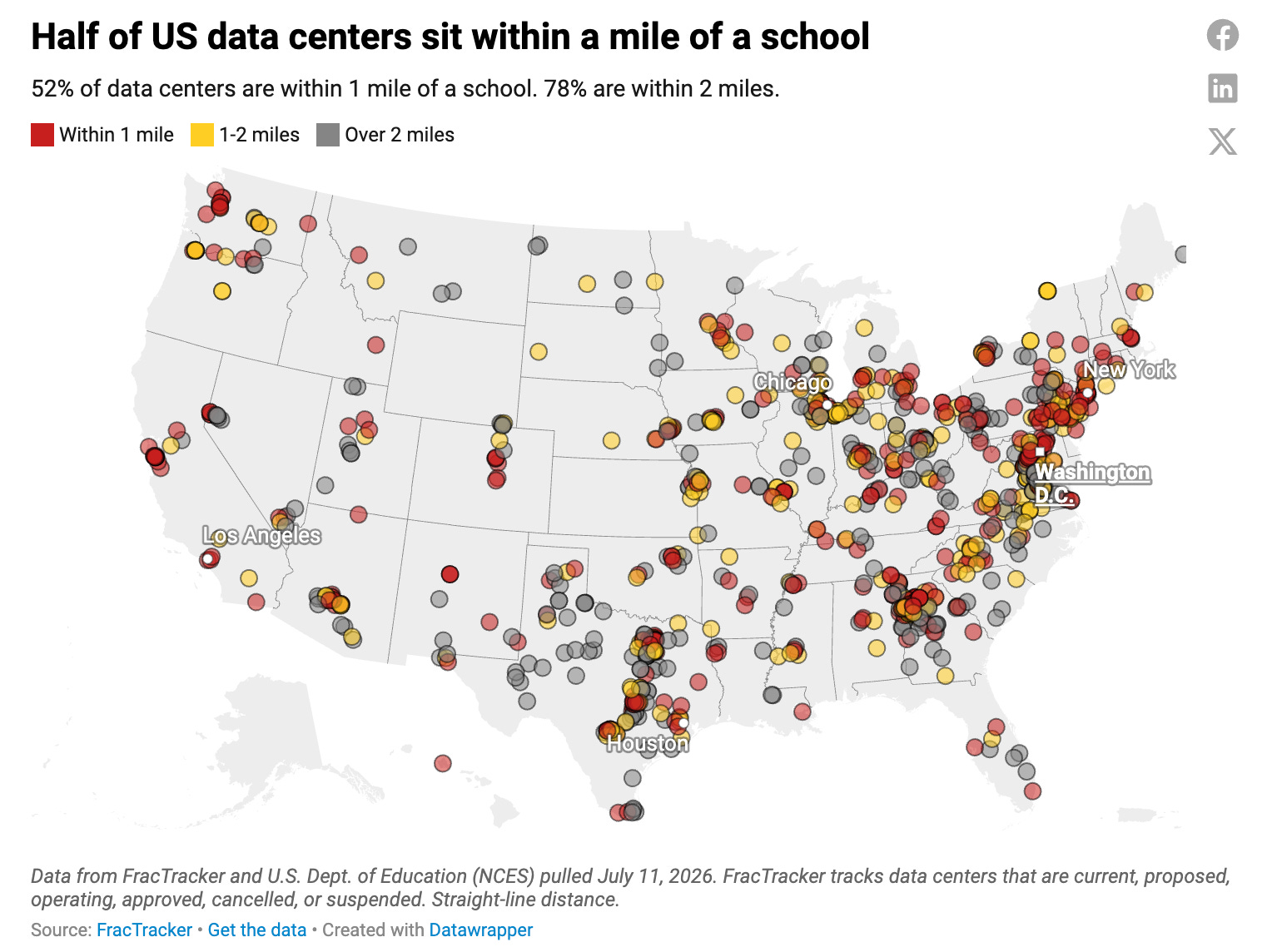
As a mother, these statistics terrify me. Knowing what we know about the consequences of being in close proximity to a data center, alarms should be ringing in all of our heads. Our babies are guinea pigs for America’s race against… China?… and intellectualism… and wealth equity. Because, to be clear, we are not the ones who will benefit from artificial intelligence. Tech billionaires will become trillionaires and our children will only be sicker for it.
The same Trump Administration that has ran on a “Families First” mandate has recently linked the data center boom to national security meaning we are being told to choose between the health of the most vulnerable among us and our safety. But this is a false dichotomy. Data centers and artificial intelligence are not essential. We do not need them so much as we wish to remain ahead of the global curve. What we need is clean air, clean water, and the ability to power the infrastructure that actually keeps us healthy and safe.
I refuse to be immobilized by hopelessness when citizens are stopping data center projects in their tracks and pushing elected officials for moratoriums on new developments until further regulation is implemented. I will continue to ask questions about the bets being placed at my boys’ expense. I am inspired by the Mari and Sadie’s of the world but I also hope to usher in a world where children don’t have to write letters to Presidents or attend city council meetings to address the problems caused by adults. I’m rolling up my sleeves and I hope you will too.
Even when Trump is no longer President, we will still need to face ourselves. Will we choose ChatGPT, Gemini, and Claude even when we know the cost to our children? Will we re-elect the politicians who gave tax breaks to these projects?
Who — or what — will you safeguard?